Part 2: Are you Ready for the Transition?
- Define your IFRS 18 target state first. Before diving into technical changes, organisations must clearly define their desired reporting structure, including key subtotals and MPMs. This forms the foundation for all subsequent design and implementation decisions.
- Consistency across entities and systems is critical
Building on the data and classification challenges highlighted in Part 1, success depends on clear, central guidelines and the ability of all entities to deliver structured, consistent data without relying on manual workarounds. - Use the checklist to avoid complexity and rework
Ultimately, IFRS 18 implementation is about making the right design choices early around classification, CoA structure, and system setup to avoid over-engineering and ensure a scalable, future-proof solution.
In our previous article, Getting Started with IFRS 18 Implementation, we explored the key challenges organisations face when translating IFRS 18 into practice. These included a chart of accounts redesign, multi-entity data alignment, and the risk of over-engineering reporting structures.
Building on these insights, this article focuses on the next step: preparation.
Based on our implementation experience, we introduce a practical IFRS 18 checklist to help organisations define their target reporting state, structure the transition, and avoid common pitfalls early.
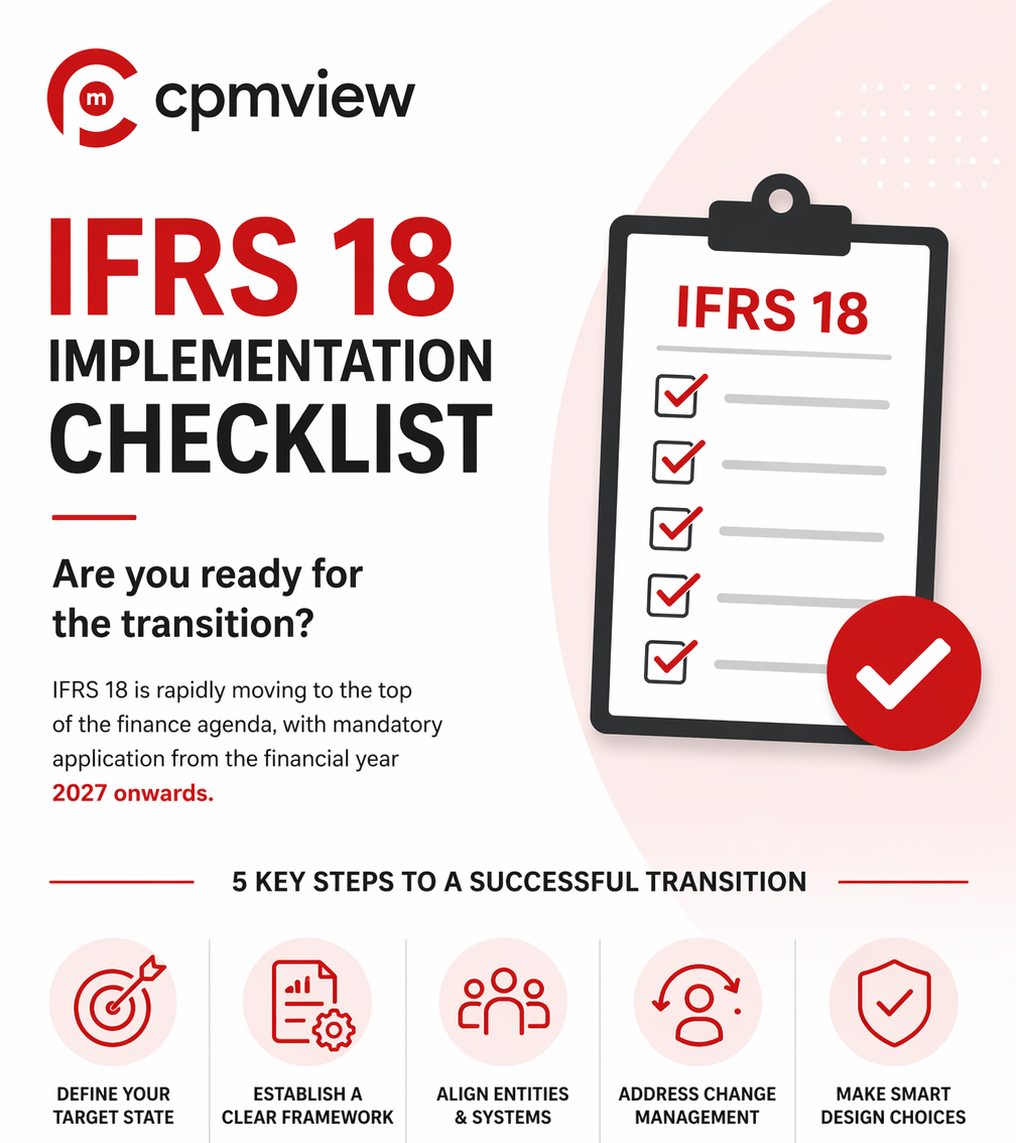
1. Defining your IFRS 18 Target State Early
In practice, many organisations make the mistake of diving straight into technical requirements. However, successful IFRS 18 implementations start with a clear question:
What should your financial reporting and year-end close look like under IFRS 18?
Only once this is defined can you determine:
- Whether a direct transition is feasible, or
- Whether a phased approach with parallel reporting is required.
A clearly defined target state provides direction, prevents rework and enables more realistic planning.
Checklist Questions:
- Have we defined what our IFRS 18 financial statements should look like?
- What Management-Defined Performance Measures (MPMs) are used in the financial statements and other external publications?
- Are any MPMs contractually defined within reporting obligations to financial institutions or other stakeholders?
- Has the Board formally approved the MPMs applied in the financial statements and other external publications?
- Do we plan a direct switch to IFRS 18 or a period of parallel reporting?
- If so, is our organisation ready to tackle the extra workload of parallel reporting?
- Have we prepared a timeframe for the transition process, and is this feasible?
2. Establishing a Clear IFRS 18 Classification, CoA and MPM Framework
IFRS 18 classification requirements may seem straightforward on paper, but are often complex in practice.
Without clear, centrally defined guidance:
- Inconsistent classification quickly emerges,
- Data comparability is reduced,
- And consequently, the redesign of the Chart of Accounts (CoA) becomes fragmented.
As highlighted in our previous article, the CoA redesign is one of the most impactful parts of IFRS 18, affecting:
- Reporting structures,
- Data collection,
- Controls and reconciliations,
- And historical comparatives.
A structured, principle-based approach is therefore essential to maintain both accuracy and scalability.
Checklist Questions:
- Are the definitions and accounting rules clear for the classification of new IFRS 18 accounts and the impact on current accounts, and included in the accounting policies?
- Are these interpretations and rules consistent between groups and local entities?
- Is it clear which existing accounts must be split/expanded, and the impact they have on the CoA?
- Are the definitions and the accounting policies of the MPMs established?
- Is it clearly defined how MPMs can be measured in an auditable manner, including the impact of tax (considering multiple approaches) and non-controlling interests?
3. Plan for Multi-Entity Coordination and New Reporting Lines
The complexity of IFRS 18 increases significantly in multi-entity environments.
With new subtotals and a stronger focus on structured operating profit measures, alignment across entities becomes critical. Otherwise, differences in interpretation or data delivery can quickly lead to inconsistencies in group reporting.
As a result, effective implementation requires:
- Clear central governance,
- Aligned interpretation of classification principles,
- Disciplined execution at the local level.
Checklist Questions:
- Are IFRS 18 requirements communicated clearly to all entities?
- Have we defined a clear overview of all systems (ERP, consolidation, disclosure solution, analytic tools) to be affected?
- Do we have a clear transition/change plan for these systems to be adjusted?
- Can all entities deliver the newly structured data on time?
- Should the new reporting structure and MPMs also be reflected in internal management reporting and bonus calculations?
4. Address Change Management Explicitly
IFRS 18 impacts more than reporting structures and systems. In fact, it changes how financial data is captured, assessed and explained. In practice, the biggest challenge is often ensuring that local finance teams can provide data at the required level and understand the new logic behind operating and non-operating classifications. Without early alignment and training:
- Inconsistent interpretations arise,
- Manual workarounds increase,
- And ultimately, data quality deteriorates.
A structured change approach is therefore critical.
Checklist Questions:
- Are local finance teams prepared to capture and assess data in line with IFRS 18 requirements (e.g. operating vs non‑operating)?
- Do the local finance teams use approved cost allocation mechanisms to allocate financial figures across operating, investing, and financing activities?
- Do the local finance teams apply an approved allocation methodology when retrospectively allocating restated 2026 figures?
- Do the local finance teams rely on additional processes or manual controls to validate the allocation between operating, investing, and financing activities?
- Are there any anticipated discontinued or disposed operations that need to be reported in accordance with IAS 1 and IFRS 18?
- Has change management started early enough, alongside or before technical implementation?
- What are the mitigation measures in case changes in the system and/or process can’t be delivered on time?
5. Design Choices: Customisation vs Future-Proofing
Implementing IFRS 18 requires design decisions around the Chart of Accounts, hierarchies and calculation logic. As highlighted in our previous article, over-engineering is a major risk.
On the one hand, highly customised solutions may solve short-term issues. On the other hand, they often introduce complexity that:
- Reduces transparency,
- Increases maintenance effort,
- And limit flexibility over time.
A simpler, principle-driven design is therefore often more sustainable.
Checklist Questions:
- Have we consciously thought about customisation and exceptions in our IFRS 18 design?
- Are bridging solutions and parallel reporting structures clearly defined as temporary or structural?
- Are reporting structures and calculation rules simple and dynamic enough to accommodate future changes?
How to Achieve a Controlled and Efficient IFRS 18 Transition
IFRS 18 implementation is not merely about technical compliance. Rather, it requires a coordinated transformation across systems, processes, and people.
Based on our implementation experience, organisations that:
- Define a clear target state,
- Align classification and CoA design early,
- Coordinate across entities,
- Invest in change management,
- And avoid unnecessary complexity
are significantly better positioned to deliver a controlled and efficient transition.
While each organisation starts from a different point, the challenges we see in practice are often the same. A structured, pragmatic approach makes the difference between a reactive implementation and a sustainable, future-proof reporting model.
Ready to assess your IFRS 18 readiness or start the transition? Get in touch with one of our experts!